
Nov 13, 2026
What does non-flanged mean on a pipe plug?
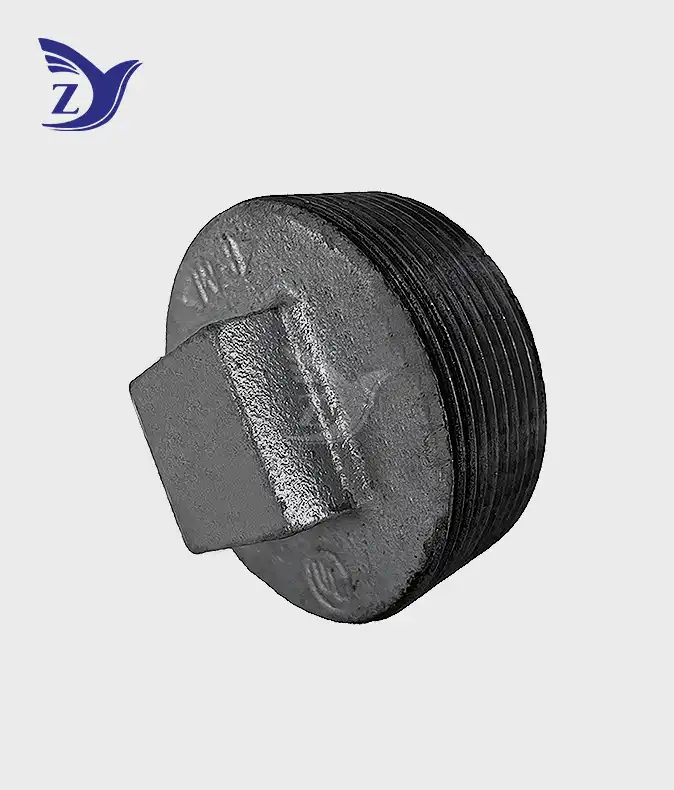
What does "non-flanged" mean? It comes down to the design of the head profile. The head of galvanized non-flanged pipe plug pipe fittings is square or hex-shaped and fits flush against the pipe opening, without a collar or raised rim at the base. This compact shape is ideal for tight installations with limited space. Hot-dipped zinc coating over malleable iron for corrosion resistance of the assembly in water, gas and oil pipeline systems with NPT or BSPT thread standards. Galvanized non-flanged pipe plug pipe fitting.
Understanding Non-Flanged Pipe Plugs
What "Non-Flanged" Actually Means
Non-flanged means a plug with a threaded body that goes directly to a square or hex wrench head without an extended rim, washer face or collar. This design maintains a low installed profile, an advantage in recessed manifolds and panel-mounted pipe arrays where a flanged rim would physically obstruct the wrench or prevent full thread engagement.
Key Specifications at a Glance
The standard NPT/BSPT threads are ANSI/ASME B1.20.1 (NPT) or ISO 7-1/BS 21 (BSPT) for an unflanged galvanized malleable plug. Sizes usually range from 1/8" to 4". The hot-dipped galvanized coating is typically 70-85 microns thick per ASTM A153. The malleable iron body is per ASTM A197. Class 150 plugs are rated at 300 psi WOG. Class 300 plugs take up to 1,000 psi WOG.
Why Galvanizing Matters for These Plugs
The zinc coating on galvanized non-flanged pipe plug pipe fittings acts as a sacrificial anode, corroding before the iron beneath it. Proper hot dip coating can achieve more than 500 hours without red rust formation under salt spray tests according to ASTM B117. This protection extends the life of the fitting by 20 to 50 years over bare black iron for outdoor installations, coastal pipelines or humid industrial environments.
Comparing Flanged and Non-Flanged Pipe Plugs for Industrial Use
Structural Differences That Affect Performance
The base rim of a flanged plug is bigger, which spreads the stress of sitting on the pipe face. When there is a gasket or O-ring face seal built into the design, this works well. All the force goes through the hex or square body column of a plug that doesn't have a lip. This makes the thread tension between the metals more direct, which is what makes an NPT taper seal work.
Cost and Installation Efficiency
In real life, non-flanged patterns are better for these key reasons:
- Space savings: Its small footprint makes it possible to install in tight or clustered pipe assemblies where a flanged collar can’t fit without additional machining for clearance.
- Torque transfer: Galvanized non-flanged pipe plug pipe fittings can take higher wrench torque during assembly decreasing the likelihood of leaks in high-vibration environments because there is no rim to crack or deform.
- Unit cost: A distributor is buying thousands of pieces per container load, and the cost per piece is less without the extra material in the flange.
Because of these pros, the non-flanged style is the standard way to close industrial gas and water pipelines in North America and other places.
Corrosion and Pressure Durability
Parts made of black iron break easily when they're hot or when the chemicals are strong. Hot-dipped galvanized non-flanged plugs with precision threads keep the thread form within spec and stop oxidation. This is important because galvanization adds a layer to the thread crests that can be observed. After hardening each batch, Zhiyuan Malleable Iron checks the thread sizes to make sure they work with NPT and BSPT fittings and can close well.
How to Install and Maintain Galvanized Non-Flanged Pipe Plugs
Step-by-Step Installation
Before you put the male threads in, wrap them twice or three times in PTFE tape or pipe thread sealant. Thread the plug in by hand until it fits tightly to make it tighter. Then, use a pipe wrench or socket wrench to get the right torque. For 1/2" NPT, the torque is usually 30–50 ft-lb, but it can be higher depending on the pipe size. Do not tighten too much; the taper seal should only touch slowly, and if you use too much force, the casting could break.
Routine Maintenance Practices
Every year, check galvanized non-flanged pipe plug pipe fittings that don't have flanges for zinc loss, thread galling, or white rust at the hex head. The white rust, which is made up of zinc oxide crystals, is only there for looks in the beginning. If there is base metal rust on the plug, it should be changed before the system is put under pressure. Take the plug out and put it back in. Then, use a stiff wire brush to clean the threads and put the sealer back on.
Troubleshooting Common Issues
If there are leaks after installation, it's usually because there isn't enough thread sealer, the thread standards don't match (NPT fittings into BSPT ones), or there is a flaw in the casting, like sand getting into the hole. Before Zhiyuan Malleable Ironsends out any samples, they test them hydrostatically at 1.5 times the working pressure. They also use a "go/no-go" thread scale to check each production batch and see if any of the sizes are off before they are packed.
Procurement Considerations for Galvanized Non-Flanged Pipe Plugs
Evaluating Supplier Quality Certifications
You need to get licenses when you buy galvanized non-flanged pipe plug pipe fittings from a business to business. For systems that protect against fire, look for UL/FM lists, CE marking to get into the European market, and ISO 9001 quality control. Not only can a factory say they have process control, but they can also show test reports with information like the thickness of the zinc coating, the tensile strength, and the thread gage records.
Balancing MOQ, Lead Time, and Inventory Cost
The costs of buying pipe plugs depend on how much they cost and how quickly they can be delivered to distributors. Look at these things before you buy:
- MOQ flexibility: A plant with a 30,000-ton-per-year capacity can accommodate orders for containers (20GP/40HQ) without affecting the production schedules of other SKUs.
- Price tiers: By offering tiered pricing from 1/8” through 4” across both NPT and BSPT standards, a distributor can consolidate purchasing with one supplier instead of splitting orders.
- Delivery window: Custom OEM batches will need to be scheduled for production (and will be communicated at order placement). Standard products ship from warehouse stock.
OEM and Packaging Options
With ODM/OEM services, distributors can make their own private-label product lines. They can choose the labels, the style of the packaging, and the paperwork for proving the product's country of origin. Galvanized surfaces stay safe during ocean freight when they are packed in export-standard weave bags or wooden crates with a moisture-barrier lining. This stops the white rust that causes problems later on.
Practical Applications and Industry Use Cases
Water and Gas Pipeline Systems
Standard galvanized non-flanged pipe plug pipe fittings made for industrial use are often used to block off HVAC water lines, natural gas lines, and public water lines. A set of rules called ASME B31.1/B31.3 says that plugs with NPT threads can be used in Class 150 situations. When something is buried or partially buried, the wetness and condensation that come with it can't hurt a hot-dipped zinc surface.
Construction and Oil & Gas Projects
That way, empty branch ports on construction sites will stay closed while the final connections are being made. This is made possible by pipeline caps that don't rust. Solid (non-cored) Class 300 unflanged plugs can handle pressure changes in oil field gathering lines that would bend cored items. In Southeast Asia, a project manager was looking for fittings to improve the gas distribution system. They switched to galvanized malleable iron non-flanged plugs because the zinc coating meant they didn't have to check for corrosion every week with bare iron in the humid climate.
Export Market Demand Patterns
Distributors who work with the Middle East, Southeast Asia, and Africa often need galvanized non-flanged pipe plug pipe fittings that fit NPT and BSPT threads and close tightly. You can see this because there are both older Commonwealth pipes (BSPT) installations and newer American-standard (NPT) installations in these places. People who sell galvanized malleable iron can serve both types of customers from the same stock line if they have both types of thread in that series.
Conclusion
Galvanized non-flanged pipe plug pipe fittings feature a unique low-profile, collar-free head design for direct thread engagement and positive taper sealing on NPT and BSPT piping systems. These fittings are made from malleable iron and are protected by hot-dip galvanization, providing reliable corrosion resistance, stable pressure performance, and excellent torque tolerance. This makes them a practical choice for water, gas, and oil applications in demanding indoor, outdoor, and coastal environments.
Compared to flanged alternatives, their compact form factor solves installation constraints in cramped, clustered pipe layouts, while the elimination of additional flange material helps keep procurement costs competitive. Proper installation with thread sealant and regular inspection can maximize the service life and minimize the risk of leaks.
Zhiyuan Malleable Iron is a trusted manufacturer that aligns production with global industry norms and adheres to strict batch testing for thread accuracy, coating quality and pressure integrity. For decades, galvanized non-flanged malleable iron plugs have been the standard cost-effective sealing solution on industrial and pipeline projects around the world, whether standard stock orders or custom OEM requirements.
FAQ
Are galvanized non-flanged pipe plugs suitable for high-pressure gas lines?
Yes, Class 300 solid plugs with a 1,000-psi WOG grade can be used in many industrial gas settings. Before you install, make sure that the fitting's number matches the system's design pressure and that it meets the ASME B31.1 or B31.3 code standards in your area.
How does galvanized corrosion resistance compare to stainless steel?
Since the zinc coating is hot-dipped, it rusts before the base iron does. This is called "sacrificial anodic protection." A layer of chromium oxide that is not active keeps stainless steel from rusting. For general water and gas service, galvanized malleable iron is much less expensive per unit and lasts long enough in most non-acidic places.
How can I verify the zinc coating thickness on a supplier's product?
Please ask for a report on the measurements made with the magnetic induction tester. In order to hot-dip coat threaded fittings, ASTM A153 says that the thickness must be at least 63 microns on average. Every shipment from a reliable factory will come with a batch test certificate.
Do I need thread sealant with NPT non-flanged plugs?
Yes, you need PTFE tape or pipe-grade thread compound to seal the spiral leak path that comes with NPT geometry and keep the threads from galling on the galvanized surface while they are being put together.
What is the difference between cored and solid non-flanged plugs?
The solid casts or full bar stock that solid plugs are made from make them stronger. In order to save money on materials, cored plugs have an empty bottom. This means that they can only be used in Class 150 lower-pressure water services.
Source Your Galvanized Non-Flanged Pipe Plug Pipe Fittings from Zhiyuan Malleable Iron
Zhiyuan Malleable Iron has been using malleable iron to make pipe parts since 2006. Every year, they can make 30,000 tons of them, and there are more than 1,000 SKUs that are still in use. There are NPT and BSPT sizes from 1/8" to 4" that we can make galvanized non-flanged pipe plug pipe fittings for. They all meet ISO 9001, CE, UL, and FM standards. To get a catalog, a tiered price list, or a sample order, email us at q1236800000@gmail.com or visit zymalleablepipefitting.com.
References
- American Society of Mechanical Engineers. ASME B1.20.1: Pipe Threads, General Purpose (Inch). ASME, 2013.
- ASTM International. ASTM A153/A153M: Standard Specification for Zinc Coating (Hot-Dip) on Iron and Steel Hardware. ASTM International, 2016.
- ASTM International. ASTM A197/A197M: Standard Specification for Cupola Malleable Iron. ASTM International, 2019.
- British Standards Institution. BS EN ISO 7-1: Pipe Threads Where Pressure-Tight Joints Are Made on the Threads. BSI, 2011.
- ASTM International. ASTM B117: Standard Practice for Operating Salt Spray (Fog) Apparatus. ASTM International, 2019.
- American Society of Mechanical Engineers. ASME B31.3: Process Piping — Chemical Plant and Petroleum Refinery Piping. ASME, 2022.
Online Message