
Sep 21, 2026
NPT Galvanized Coupling Fittings: A Complete Guide
If you've ever walked a job site where a single leaking joint caused hours of rework, you already understand why fitting selection matters. NPT round face galvanized round edge coupling pipe fittings sit at the intersection of precision engineering and practical durability — and this guide breaks down everything a plumbing contractor, procurement manager, or field supervisor needs to know before placing an order.
Understanding NPT Galvanized Coupling Fittings
What Makes These Fittings Different?
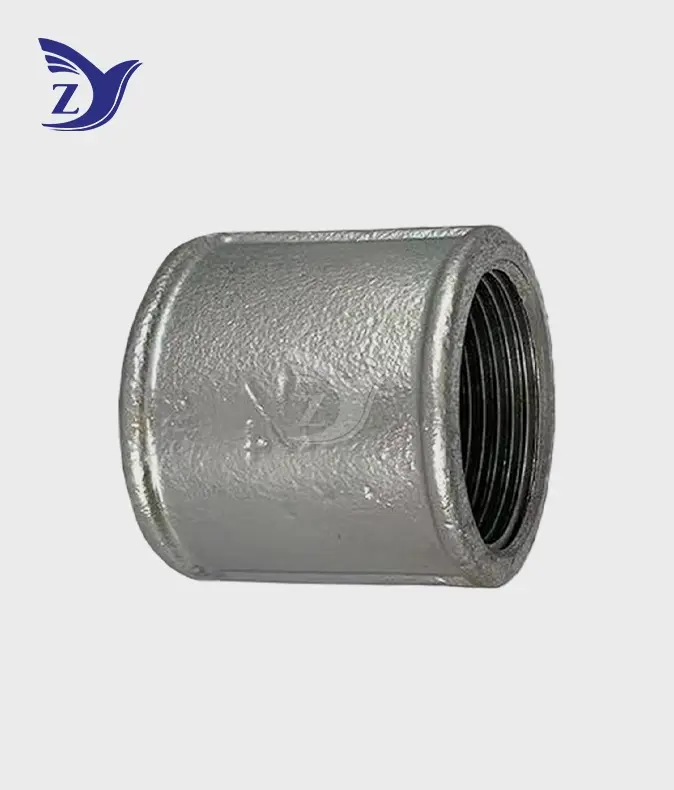
It is an iron pipe joiner that can be shaped and has two internally threaded ends, a chamfered round face entry, and a strengthened bead at each exit. The round face chamfer makes it easy for the male pipe thread to fit into the socket. This makes cross-threading much less likely during installation. The round edge bead makes the hoop stronger at the weakest point, so it works better than plain-end couplings when wrench torque and long-term internal pressure are present.
Materials and Thread Standards
The fittings are made from KTH350-10 malleable iron, which has a tensile strength of at least 350 MPa. As required by ASTM A153, a hot-dip galvanized zinc layer works as a sacrificial anode to protect the base metal in wet, chemically active, or outdoor settings. NPT threads have a 60° thread angle and a curved shape that makes a mechanical interference seal. They are in line with ANSI/ASME B1.20.1. Sizes range from 1/8" to 6", which covers almost all water and gas pipeline configurations for commercial or municipal projects.
It's important to note that NPT (60° taper) and BSPT (55° taper) are not the same thing. Putting the two standards together harms the thread crests and makes sure that they will leak. Make sure that your thread standards match the pipes you already have before you order more.
Key Benefits and Applications of Galvanized Round Edge Coupling Fittings
Hot-dip galvanized malleable iron joints are a good choice because they are not as heavy as black iron or stainless steel. Black iron valves are common in gas distribution, but they don't have any surface protection and rust quickly when they get wet or are outside. Stainless steel is very good at resisting corrosion, but it costs more than other materials, which makes it hard for mid-sized plumbing jobs to make money. Galvanized round edge fittings are just as resistant to rust as many covered options, but they cost a lot less than stainless steel ones.
In a wide range of industrial and business settings, these fittings work consistently. Here are the main areas of use that are worth mentioning:
- Commercial and municipal water distribution: For business and city water systems, the zinc finish keeps the lines from rusting in high-pressure water situations, and the precision NPT round face galvanized round edge coupling pipe fittings profile passes water tests without needing extra joint repair. It has been shown that Class 150 galvanized malleable iron fittings can last more than 25 years in water that is not acidic (ASME B16.3).
- Outdoor fire suppression systems (dry pipe): Sprinkler branch lines outside need to be resistant to corrosion all year. The round edge bead adds to the system's resistance to mechanical damage in open industrial yards, and the NPT thread keeps the system airtight so that pressure stays high between activations.
- Agricultural high-pressure irrigation: In agricultural high-pressure irrigation, different types of reducing couplings change the main lines to smaller side delivery pipes. These industrial-grade pipe connections can handle the water hammer pressure spikes that happen when a pump is turned on, and they can also withstand the soil-contact corrosion that often causes PVC options to break before they're supposed to.
These three application categories illustrate a consistent pattern: a hot-dipped galvanized, precision-threaded malleable iron coupling works better over the life of the system wherever moisture, changing pressure, and long service intervals come together.
Comparing NPT Galvanized Couplings with Other Pipe Fittings
Often, procurement teams have to choose between three competing fitting families. Understanding the trade-offs helps you avoid making mistakes that cost a lot of money.
The base of Square edge couplings is made of the same malleable iron, but they don't have an exit bead. That simplifies things, which lowers the mass of the material and, as a result, its resistance to radial stress. When there is a lot of shaking or when the temperature changes often, square edge joints wear out faster at the socket mouth. When long-term mechanical reliability is more important than saving a few cents per unit, round edge couplings are the better choice.
Forged steel fittings can handle high temperatures and high pressures; some are rated up to Class 3000. They cost a lot more per unit and need to be installed with more precise torque control. For normal water and gas distribution that works below 300 psi, Forged steel fittings are overengineered. A galvanized round edge coupling's anti-rust, pliable iron can handle the load at a price that's easy on the wallet.
Stainless steel couplings have higher temperature ranges and no chance of galvanic corrosion at all. These are the best ones to use in food-grade, medicinal, or marine settings with a lot of chloride, while NPT round face galvanized round edge coupling pipe fittings are suitable for other applications. When those special conditions aren't met, the difference in cost rarely makes the increase worth it.
Installation and Procurement Guide for NPT Galvanized Coupling Fittings
Installation Steps That Prevent Callbacks
How well you do the threading stage decides whether the joint will last for decades or break at the first pressure test. A wire brush can be used to get rid of burrs and metal shavings in pipe threads. PTFE tape or pipe dope that works with pipe threads should be used on the male thread, not the female hole. This seals the spiral leaking path that comes with any tapered thread system and keeps the joint smooth while it's being tightened, which is necessary to get a Class 150 or Class 300 pressure rating.
Tighten by hand until you feel resistance, then use a pipe wrench to move the bolt forward two or three full turns. Do not tighten too much; pliable iron can handle pressure well, but too much force can break the socket. Do a hydrostatic pressure test at 1.5 times the rated working pressure after putting the line together, before covering it or burying it.
What to Check When Sourcing
Thread gage compliance is a must when examining providers. Ask for calibrated L1 ring gage inspection reports that prove compliance with ANSI/ASME B1.20.1. Check that the galvanization meets ASTM A153 by looking at the zinc thickness records and the results of the Preece Test (copper sulfate dip). Following the measurements in ASME B16.3 ensures that the pipes run straight and coaxially. Certifications like CE and ISO 9001 are not just claims about quality; they provide a system that can be checked.
Trusted Supplier: Zhiyuan Malleable Steel
Since it opened in 2006, Zhiyuan Malleable Steel has been making pipe parts out of malleable iron in Taigu District, Shanxi Province. The building is 50,000 square meters, has more than 500 employees, including 38 scientific staff, and can make 30,000 tons of products each year in more than 1,000 different types.
A full ISO 9001 framework is used to make sure the quality of the products. CE, UL, and FM certifications allow them to be exported to the US, UK, Australia, and other regulated markets. Electric heating environmental protection galvanizing furnaces are used in the galvanizing workshop, and 156 sets of precision processing equipment are used in the machining area to make sure that all batches have the same tight thread tolerances.
If procurement managers are worried about lead times, Zhiyuan keeps a lot of standard sizes in stock and can ship stocked SKUs within two hours. OEM and ODM services can meet specific needs, such as BSPT thread profiles for projects outside of the U.S., without making smaller contractors meet impractical minimum order quantities.
Conclusion
There are three things that you must make sure are met before you can choose the right galvanized coupling: thread precision to make sure the installation goes smoothly; hot-dip zinc protection to make the coupling last longer in harsh conditions; and a supplier with the production discipline and certification paperwork to back up every shipment. NPT round face galvanized round edge coupling pipe fittings made to ASME B16.3 and ASTM A153 standards always meet those requirements in industrial, water, and gas pipelines. As long as the specifications are correct from the start, the fitting will rarely need to be repaired.
FAQ
1. Are galvanized couplings compatible with stainless steel pipes?
It is possible to connect galvanized malleable iron and stainless steel in the same system, but galvanic corrosion can happen when different metals touch each other, and there is water around. Putting dielectric unions or separating fittings between the two materials breaks the galvanic circuit and stops the zinc from breaking down faster at the joint.
2. What is the difference between round face and square edge couplings?
Round face is the chamfered inlet that guides thread engagement and stops threads from crossing. There is a strengthened bead at the exit that is called a "round edge." In square edge couplings, that bead isn't there, so the structure at the socket mouth isn't as strong when it's loaded with torque or vibration.
3. How long does hot-dip galvanization last in a water pipeline?
A study in the Journal of Corrosion Science and Engineering shows that hot-dip galvanized coatings on malleable iron can last 25 to 50 years in clean water settings when the covering thickness meets the ASTM A153 minimums. Conditions that are acidic or contain chlorine speed up zinc loss and shorten that window.
4. Do these fittings need thread sealant?
You have to use thread sealant. Even though NPT taper threads make a mechanical interference seal, leaks can still happen because of the spiral path between the joining crests. This is because PTFE tape or pipe dope doesn't fill the gap. Sealant also makes the joint smooth, which lowers the amount of force needed to fully connect.
Partner with Zhiyuan Malleable Steel for Your Next Project
Before 2006, Zhiyuan Malleable Steel was a reliable company that made NPT round face galvanized round edge coupling pipe fittings. They sold products that were ISO 9001, CE, UL, and FM-certified to contractors and distributors all over the U.S. Get in touch to talk about pricing for large orders, custom specifications, or certification paperwork. You can send your question to q1236800000@gmail.com, and someone will answer you right away.
References
1. American Society of Mechanical Engineers. ASME B16.3: Malleable Iron Threaded Fittings, Classes 150 and 300. ASME, 2021.
2. American Society for Testing and Materials. ASTM A153/A153M: Standard Specification for Zinc Coating (Hot-Dip) on Iron and Steel Hardware. ASTM International, 2016.
3. American National Standards Institute. ANSI/ASME B1.20.1: Pipe Threads, General Purpose (Inch). ASME, 2013.
4. Schweitzer, Philip A. Corrosion Engineering Handbook: Corrosion of Linings and Coatings. CRC Press, 2006.
5. Nayyar, Mohinder L. Piping Handbook, 7th ed. McGraw-Hill, 2000.
6. Journal of Corrosion Science and Engineering. "Long-Term Performance of Hot-Dip Galvanized Coatings in Potable Water Systems." University of Manchester, 2018.
Online Message