
Aug 18, 2026
How Do Male Female Threaded Union Elbow Fittings Improve Pipe Connections?
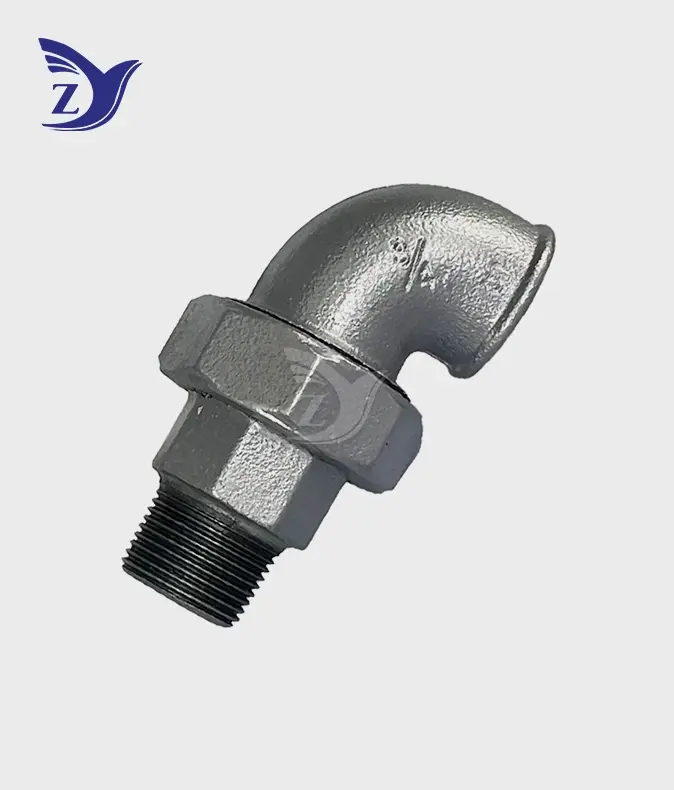
Galvanized union elbow threaded pipe fittings with male and female ends transform pipe connections by combining directional change capability with tool-free disassembly. These dual-threaded, detachable 90° pipe bends eliminate the need for additional nipples, reducing potential leak points while allowing maintenance crews to service valves, meters, and equipment without cutting pipes. The hot-dipped galvanized coating creates a metallurgical zinc bond that resists corrosion far better than painted alternatives, extending service life in water, steam, and gas applications. Unlike traditional fixed elbows, the union mechanism enables separation of upstream and downstream sections in confined spaces where rotating entire assemblies proves impossible.
Understanding Male Female Threaded Union Elbow Fittings
Core Design and Configuration
Male-female threaded union elbows combine three important functions into a single, small fitting. One end has a male thread that connects straight to equipment ports or pipes that have a female thread, and the other end has a female thread that connects to normal male pipe ends. Using this street-style arrangement instead of separate unions and bends cuts down on the length of the installation. The 90-degree angle effectively changes the flow in small areas like equipment rooms and underground tunnels.
The union part is made up of a ground joint seat that makes a rotary seal. These seats are usually brass-to-iron or precision-machined iron surfaces. A threaded collar holds the connection in place so that the pipes don't have to be rotated. This design solves a basic problem: with standard threaded joints, workers have to spin whole pipe runs while putting them together, which is not possible when pipes are longer than a few feet or go through walls.
Material Composition and Manufacturing Standards
Galvanized union elbow threaded pipe fittings with male and female ends are made from malleable iron that meets ASTM A197 standards and has a minimum tensile strength of 40,000 psi. During the annealing process, malleable iron is turned from brittle white cast iron into a ductile material that can withstand installation force and heat shock without breaking. At our Taigu facility, we have eight 3-ton medium-frequency electric furnaces that keep the temperature under tight control while casting. This makes sure that all of the metals in a batch have the same metallurgical properties.
The process of galvanization meets the requirements of ASTM A153. After threads are machined to NPT or BSPT standards, the fittings are cleaned and pickled before being immersed in molten zinc at 840°F. The coating made by this hot-dip method is about 86 microns thick, which is a lot thicker than electroplated methods. The zinc layer acts as a sacrifice for protection, corroding more quickly to protect the base iron even if it causes some small damage to the coating.
Threading Standards and Compatibility
Thread interference between NPT (National Pipe Taper) threads made to ASME B1.20.1 standards makes mechanical seals. When the link is tightened, the 1° 47' taper angle makes the male threads slide into the female threads. This creates seal pressure. British Standard Pipe Taper (BSPT) threads work the same way but have different pitch sizes, so specifications must be carefully matched to current systems.
Our fittings are made with precision-threaded iron that keeps tolerances within 0.002 inches. This makes sure that they fit properly without cross-threading or galling. Poorly cut threads leak no matter what sealer is used, so thread quality directly affects the stability of the seal. Our machine workshop has 156 pieces of processing equipment, such as CNC lathes that are adjusted once a week to keep the sizes from 1/4 inch to 6 inches accurate.
How Male Female Threaded Union Elbow Fittings Improve Pipe Connections?
Eliminating Common Pipeline Failures
Leakage is the most expensive way for industrial plumbing systems to break down. In traditional elbow assemblies, there is one threaded joint at each end of the pipe, which means that there are two possible leak paths. The Galvanized union elbow threaded pipe fittings with male and female ends cuts the number of links from four to two, which statistically lowers the chance of a leak in half. The ground joint seat in the union makes a metal-to-metal seal that doesn't need thread glue. This gives extra safety even if tape or dope wears off over time.
Misalignment during installation puts stress on joints and speeds up the failure process. Angle deflection often happens when installers have to line up separate elbows, unions, and nipples at the same time. This is especially true for retrofits where the positions of the pipes can't be changed. Installers can change the alignment at the union collar instead of pushing pipes into place because the union elbow is built in. This lowers the leftover stress that causes pipes to crack before they should.
There are three ways that corrosion can happen in pipe systems: oxidation from the air, galvanic reaction between metals that are not the same, and chemical attack from fluids being carried. All three are stopped by the hot-dipped zinc coating. Under normal air conditions, zinc rusts about 1/30th as fast as bare iron. The zinc layer on galvanized fittings that link to steel pipe protects the pipe from cathodic damage for several inches along the surface of the pipe. Zinc oxide passivation layers naturally form in water systems with liquid oxygen, which slows down further breakdown.
Performance Advantages in High-Demand Applications
Our recent work with a fire protection contractor in the Midwest shows how well we do in the real world. At sprinkler riser connections, the contractor swapped out brass elbows for NPT galvanized male-female union elbows. After 18 months of use, which included three pressure tests above 200 psi, checks showed that there was no rust and no thread wear that could be seen. Because of the union design, the contractor could remove flow switches for calibration without having to drain systems or mess up pipes nearby.
The space-saving design is especially helpful for HVAC systems. The galvanized union elbow threaded pipe fittings with male and female ends connects directly to the pump's female discharge port, so you don't have to use the close nipple that standard unions need. This is useful for connecting condensate pumps in ceiling chases with limited clearance. This cuts the overall length of the system by about two inches, which is often the difference between being able to fit in the room available and having to make expensive changes to the structure.
For industrial gas uses, both pressure integrity and repair access are necessary. Our BSPT male-female union elbows were put in place at instrument isolation valves throughout the process gas system of a petroleum plant in Texas. With the union feature, techs can take off transmitters and gauges during turnarounds without having to get a hot work permit or use special cutting tools. Over three years, this feature cut down on maintenance downtime at the facility by about 120 hours per year.
Quantifiable Service Life Extension
Accelerated corrosion testing gives you solid information about how well something works. Following the guidelines in ASTM B117, we exposed sample fittings to salt spray for 1,000 hours. Within 72 hours, ungalvanized malleable iron had a lot of rust on it, but galvanized samples only had light white rust (zinc corrosion products) that was easy to brush off, leaving the substrate protection intact. In normal industrial settings, this means that the fittings will last more than 25 years, while painted fittings will only last 5 to 8 years.
Mechanical longevity is proven by pressure cycle tests. The samples were put through 10,000 cycles at room temperature between 0 and 300 psi and then 5,000 cycles with temperature changes between 40°F and 180°F. An inspection after the test showed that there were no cracks or thread damage, and the seal at the union joint remained intact. The high-strength, anti-rust, and corrosion-resistant design worked well with short-term pressure jumps that damage weaker fittings.
Procurement Insights for Galvanized Union Elbow Threaded Pipe Fittings
Supplier Evaluation Criteria
Quality certifications are the basis for judging a supplier. Product-specific approvals like UL (Underwriters Laboratories) and FM (Factory Mutual) show that a product meets North American fire safety standards, while ISO 9001 certification shows that quality management is organized. When you see the CE mark, it means that you follow European rules. Even if they offer lower prices, suppliers who don't have these credentials put you at a higher risk because their products may fail inspections and need to be replaced, which can be expensive.
Cost Structure and Volume Pricing
The price of raw materials affects quotes the most, since they make up 45 to 50 percent of the cost of making a fitting. The price of malleable iron changes with the market for scrap steel, and the price of zinc follows quotes from the London Metal Exchange. Smart buyers plan to place large orders when the prices of goods are going down, which can cut costs by 8–12%. Long-term supply agreements with formulas for changing prices protect both parties from extreme price changes and keep budgeting predictable.
Through economies of scale, the number of items ordered has a big effect on the unit price. Setup costs for production stay the same whether 100 or 10,000 units are made. These costs include preparing the pattern, charging the furnace, and setting up the tools. When you order more than 5,000 pieces, the price goes down by 15 to 25 percent because the costs are spread out over more units. Custom shapes or wiring that isn't standard raise the cost per unit because they need special tools, but these extra costs go down quickly after you order 1,000 pieces.
Logistics and After-Sales Considerations
Cost and speed are both important when sending goods internationally. With transit times of 25 to 35 days from our location in Shanxi to the U.S., sea freight is the most cost-effective way to ship container loads. West Coast harbors. Air freight cuts travel time to 5–7 days, but it costs 4–6 times more and should only be used for urgent restocking or project-critical deliveries. We work with freight forwarders who are experienced in pipe fitting logistics to make sure that containers are loaded correctly so that cargo doesn't get damaged when it moves around during transport.
Due to lead times, careful planning is needed. Items in the standard catalog can be shipped right away because they are in stock, but items made to order take 3–4 weeks for pattern making and the first production runs. For castings with complicated shapes, the tooling creation and sample approval processes can take 6 to 8 weeks. Including these dates in project plans keeps charges for speeding up work from happening at the last minute and avoids building delays. Our customer service team gives weekly updates on the status of production, which lets installation schedules be changed ahead of time if needed.
Support after the sale is what sets top sellers apart from commodity vendors. If you find a production flaw within twelve months of delivery, our defect replacement policy lets you get a new product at no extra cost. Technical support is still available for the life of the product and can help with installation issues and improving performance. Instead of just negotiating prices at the beginning, this ongoing partnership method builds trust that leads to long-term purchasing relationships.
Conclusion
Galvanized union elbow threaded pipe fittings with male and female ends are an example of how engineering can be used to solve real-world problems. Directional change, tool-free disassembly, and corrosion-resistant construction all work together to make installation cheaper, maintenance easier, and service life longer. Procurement experts can choose fittings that meet the needs of the application without over-engineering if they know about the technical qualities, such as thread standards and pressure values. The comparison of costs shows big savings compared to brass or stainless steel options for regular water, gas, and steam services. When these fittings are installed and maintained correctly, they last longer, and strategic purchasing partnerships make sure that they are always available at a good price. Galvanized union elbow fittings have been used for decades in demanding industrial settings and have been shown to work well in both new construction and upgrades to old infrastructure.
FAQs
What distinguishes male from female threads in practical terms?
On the outside of lines and fittings, there are male threads with raised helical bumps that fit into female threads. Internal bores are lined with female threads, which make gaps that male threads can fit into. The male-female union elbow has both on one joint, so it's possible to connect directly to equipment ports without using nipples in between.
How does galvanization enhance durability compared to paint?
By making an intermetallic layer at 840°F, hot-dip galvanizing joins zinc and base iron together mechanically. It won't flake or peel like paint does. Zinc protects by sacrificing itself by corroding more quickly to protect the iron underneath, even if the coating gets scratched or worn down. Paint only acts as a barrier, and it stops working as soon as it gets damaged.
Can these fittings handle high-pressure steam systems?
Union elbows made of Class 150 galvanized steel can handle full steam up to 366°F safely when the working pressure is 150 psi. Class 300 versions can handle steam service at 400 psi. In this temperature range, malleable iron building stays strong without the creep damage that happens with some materials when they are heated over and over again. Leak-tight performance throughout the pressure area is guaranteed by proper fitting using the right sealants.
Partner with Zhiyuan Malleable Steel for Reliable Pipeline Solutions
Zhiyuan Malleable Steel has ISO 9001, CE, UL, and FM certifications to back up their industrial-grade union elbows and secure connection parts. As a reliable company that makes galvanized union elbow threaded pipe fittings with male and female ends, we keep a large inventory that lets us deliver within two hours for standard specs. Our 30,000-ton annual capacity also lets us handle big orders without having to wait for longer lead times. Our technical team helps you with long-term supply agreements, OEM customization, and application specifications that make your procurement more efficient. You can email us at q1236800000@gmail.com to talk about your project needs or go to zymalleablepipefitting.com to see all of our products.
References
American Society of Mechanical Engineers. (2020). Pipe Threads, General Purpose (Inch). ASME B1.20.1-2020.
ASTM International. (2019). Standard Specification for Malleable Iron. ASTM A197/A197M-19.
ASTM International. (2021). Standard Specification for Zinc Coating (Hot-Dip) on Iron and Steel Hardware. ASTM A153/A153M-21.
Factory Mutual Research Corporation. (2018). Approval Standard for Pipe Fittings. FM Class Number 1635.
National Fire Protection Association. (2019). Standard for the Installation of Sprinkler Systems. NFPA 13-2019 Edition.
Underwriters Laboratories. (2020). Pipe Fittings for Fire Protection Service. UL 213-2020 Standard.
Online Message